Physical Address
304 North Cardinal St.
Dorchester Center, MA 02124
Physical Address
304 North Cardinal St.
Dorchester Center, MA 02124

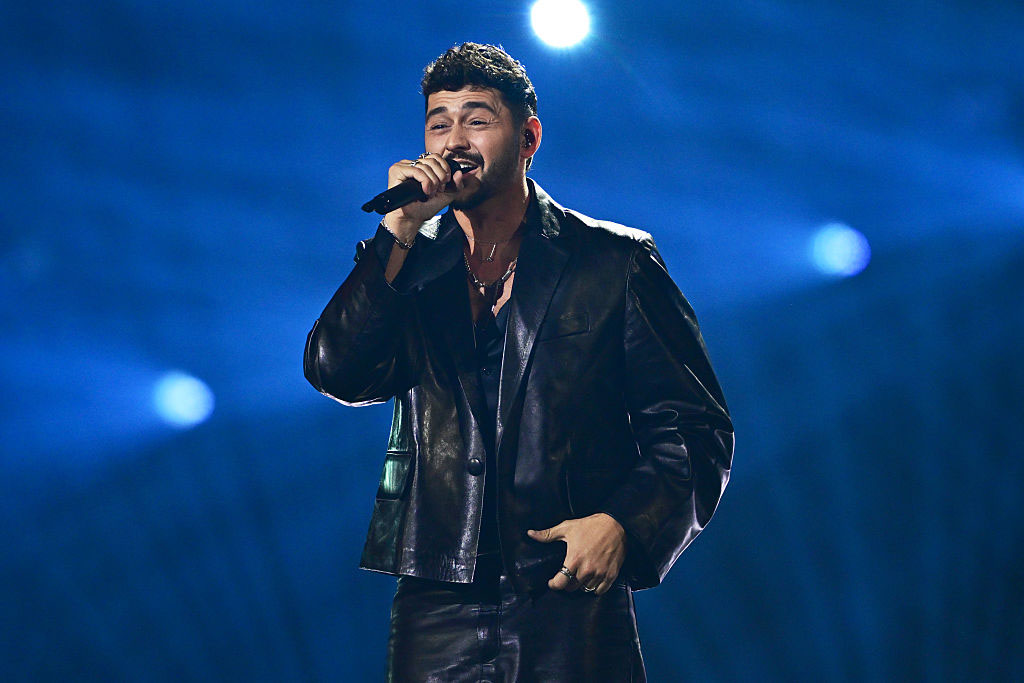
Israeli singer Noam Bettan performs 'Michelle' at the Eurovision 2026 grand final in Vienna after months of rehearsing with fake boos and a historic five-country boycott.
For months, Noam Bettan has been practicing his Eurovision performance to the sound of artificial booing. Saturday night in Vienna, it got real.
Noam Bettan, the 28-year-old Israeli singer born to French immigrant parents, took the stage at the 70th Eurovision Song Contest grand final in Vienna on Saturday. He was performing “Michelle,” a lovestruck pop song delivered partly in French, partly in Hebrew, partly in English. He was also, according to the Hollywood Reporter, performing for an audience he had spent months preparing to face.
Bettan has been rehearsing with deliberately simulated boos and heckling since late last year. The goal, per a source familiar with his preparation, was to develop unflappability without losing spontaneity. His final dress rehearsal on Saturday featured what he described afterward as the loudest booing he had ever heard. “Whatever, let’s go,” he told his backup dancers after leaving the stage. “It’s all good.”
Israel’s presence at Eurovision has been contested every year since October 7, 2023. This year, five countries are sitting out the contest entirely in protest: Spain, the Netherlands, Ireland, Iceland, and Slovenia. Spain and Ireland are among the competition’s most decorated participants, making this the most significant boycott in the contest’s history. The BBC noted that Ireland alone has won Eurovision seven times.
Austrian broadcaster ORF, which is hosting the show, confirmed it would not deploy anti-booing technology during the broadcast. That decision reversed a choice made the last time Vienna hosted Eurovision, eleven years ago, when Russian performer Polina Gagarina was booed and the jeers were replaced with artificial cheers for home viewers. During Tuesday’s semifinal, four audience members were removed by security for disruptive behavior, with one caught near a microphone as Bettan began to sing.
Bettan still qualified. He advanced alongside Greece, Finland, Belgium, Sweden, Moldova, Serbia, Croatia, Lithuania, and Poland, making this Israel’s fifth appearance in the Eurovision final in six years. Times of Israel reported that an unnamed source within the Israeli delegation believed they could top the public televote for the third consecutive year.
That would be a remarkable run. In 2024, Eden Golan finished second in the public vote with “Hurricane” and fifth overall. Last year, Yuval Raphael, a Nova massacre survivor who co-wrote this year’s “Michelle,” topped the public vote and finished second overall in Basel, where two people rushed the stage at the end of her performance and a crew member was struck with paint.
The reformed voting rules introduced this year make a repeat harder to engineer. Jury votes have been reinstated in the semifinal rounds, individual votes are now capped at 10 instead of 20, and the European Broadcasting Union promised to crack down on what it described as disproportionate government-backed promotion campaigns.
Finland’s duo of pop singer Pete Parkkonen and classical violinist Linda Lampenius, performing “Liekinheitin” (“Flamethrower”), remain the overwhelming betting favorites. But Eurovision has a long history of proving the odds wrong, and Bettan told the Jerusalem Post before the final that he intended to treat every protest as background noise. He has had a lot of practice at that.